What “Not Cooperative” Really Means
A dog labeled difficult at the vet is usually a dog who’s overwhelmed — and trying to tell you so.
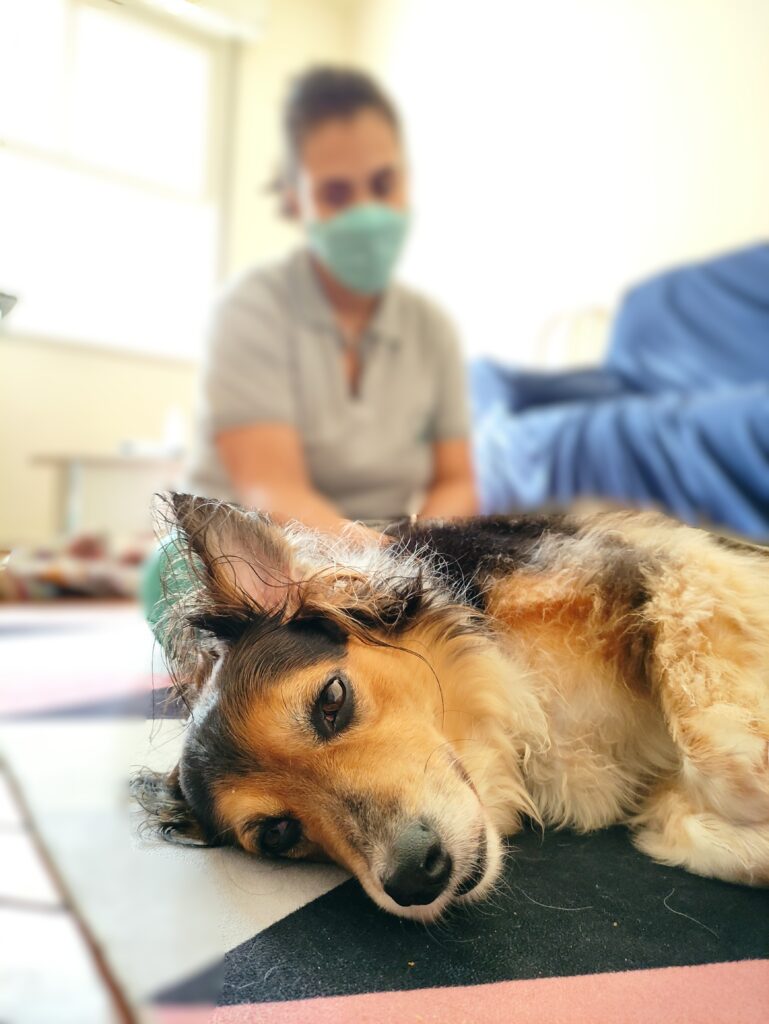
When you’re at the veterinary clinic, everything can feel stressful. Your dog may already feel stressed or anxious, which naturally makes you anxious too. On top of that, you’re worried about the cost. Needless to say, your pup probably isn’t feeling their best — unless you’re there for a routine check-up. And the last thing you want to hear is the veterinarian telling you that your dog is “not cooperative,” and writing those words into your dog’s medical record.
Well, this happened to me not that long ago. So let’s dive into what “cooperative” actually means.
What is cooperative care for dogs?
If you look at larger animal species — tigers, hippos — many zookeepers and behavior professionals have developed cooperative care techniques to collect blood samples and perform routine procedures without relying so heavily on anesthesia, which carries its own risks. Through cooperative care, we teach the animal to actively participate in their own care. In a way, we’re asking a question — “are you ready for this?” — and the animal answers by performing a trained behavior, like resting their head on the keeper’s hand until they choose to move away.
The same concept has gradually made its way into companion animal care. Today, more guardians and veterinary professionals teach dogs cooperative care so they can willingly participate in everyday care and veterinary procedures — nail trims, ear cleaning, injections, blood draws, physical exams.
This takes time to teach. But once a dog reaches the point where they can go through routine procedures using cooperative care, it becomes a game changer for everyone involved.
Cooperative care shouldn’t stop at home, though. Ideally, veterinary teams use the same approach at the clinic, adapting the environment and their handling so the dog can better predict what’s about to happen. That predictability is what helps prevent a slide into fight, flight, or freeze.
And this is where things get interesting: whether due to lack of knowledge, lack of time, or the constraints of a busy practice, not every veterinarian can accommodate a request for Fear Free care or allow time to work through cooperative care. As a result, a dog can end up labeled “not cooperative” simply for communicating discomfort and setting a boundary.
Why does cooperative care work?
The key word here is stress. We know that stress, in small amounts, is necessary for learning and adaptation in all animals, including humans. But like everything else, too much of it becomes harmful.
Now think about how long a dog may be exposed to stressful stimuli at the vet: unfamiliar smells, handling and restraint, cold sprays, needles, strange people, unfamiliar dogs, unpredictable procedures. It’s not hard to see how that stress builds up quickly. Many dogs that appear “difficult” at the vet are simply overwhelmed.
Common signs a dog is stressed at the vet:
These behaviors communicate fear or discomfort. They are not signs of stubbornness or a lack of cooperation.
Cooperative care creates a predictable chain of events. When dogs can predict what happens next, they feel more in control, more confident — and experience lower stress, even at the vet.
Can I teach cooperative care to my dog?
Absolutely.
Any dog can learn to participate in their own care, young or old, because at its core, cooperative care is about communication and consent. This benefits every dog — but in my view, it’s especially valuable for dogs who are naturally more anxious, or who communicate discomfort through behaviors we often label as aggression. Teaching cooperative care through positive reinforcement turns a dog into an active participant, rather than a passive recipient, of their own care.
Does my dog need a muzzle at the vet?
Not necessarily — and that’s not a failure either way.
A muzzle is an excellent safety tool that protects everyone involved, including the dog. Introduced gradually with positive reinforcement, a dog can wear a muzzle comfortably during procedures, without unnecessary fear or distress. Wearing a muzzle doesn’t mean a dog is “bad,” and it shouldn’t replace good handling or proper behavioral support.
The goal isn’t to replace cooperative care with a muzzle, or a muzzle with cooperative care. The two work together to make veterinary visits as safe, predictable, and stress-free as possible — for everyone involved.
Help your dog feel safe at the vet, not just tolerate it
Whether your dog freezes, growls, or shuts down at the clinic, cooperative care can change what a vet visit feels like for both of you. I help guardians build these skills at home, step by step, so appointments become predictable instead of overwhelming.
Learn more about working together