
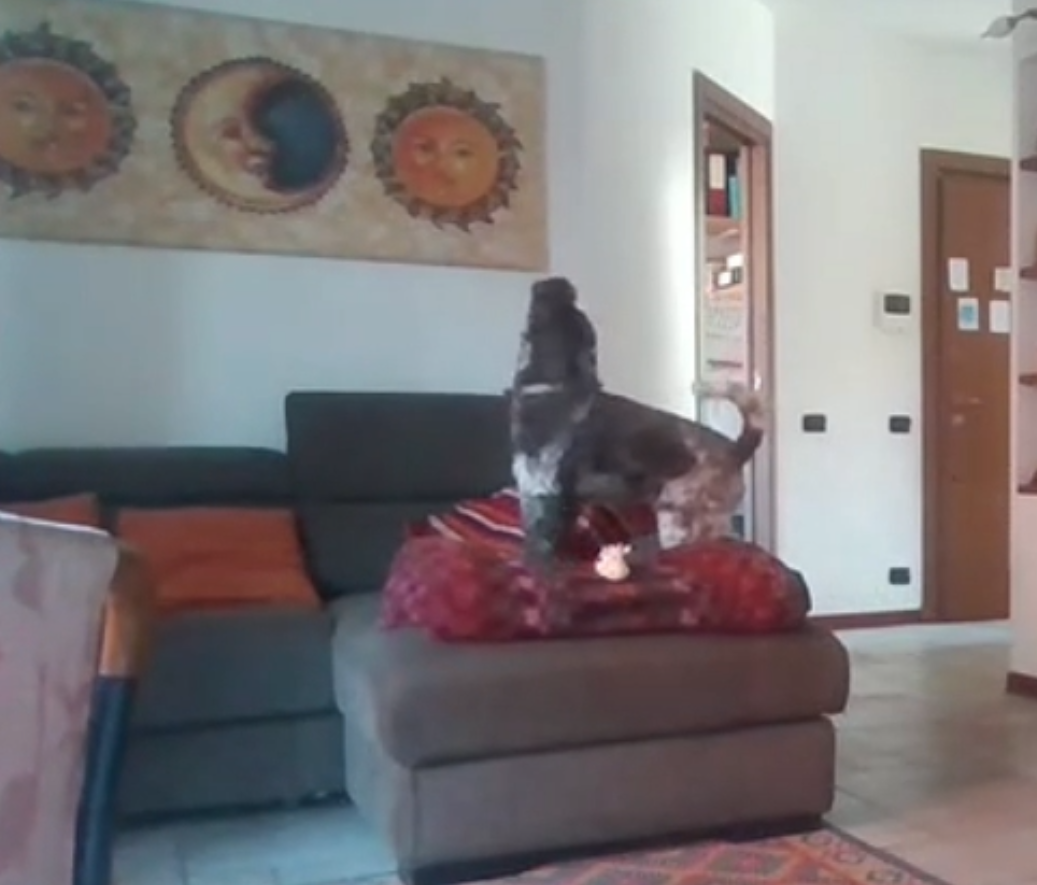
Is My Dog’s Barking a Sign of Separation Anxiety?
Barking means a dozen different things depending on when, how, and why it happens. Here’s how to read the version that shows up after you close the door.
Barking is a behavior with many different functions. A dog barks to communicate with neighboring dogs — usually answered by other dogs barking back, creating an unstoppable chain. Or they bark to alert others about potential danger, or in a higher pitch as a call to play. Barking can also just be a personality trait. However, if your dog is barking when left alone, it may indicate that they’re experiencing distress — also known as separation anxiety.
Is barking a sign that my dog has separation anxiety?
Barking has many meanings, but context matters. When left alone, dogs experience a fear similar to what puppies feel when separated from their mother at a very young age. So we have to look closely at the type of barking a dog displays when left alone to interpret what it actually means. For instance, incessant barking that shifts into a high-pitched howl can suggest the dog is in distress.
Still, barking alone doesn’t confirm separation anxiety — we always read it alongside the dog’s overall behavioral picture. And not all dogs with separation anxiety bark. Some pace, pant, drool, attempt to escape, eliminate indoors, destroy household items, or simply freeze in silence. Barking is only one possible sign of distress.
Other signs of separation-related distress:
But why is my dog afraid if they’re technically home?
It’s hard to say for certain, since we can’t directly ask a dog what they’re feeling — but we can make some pretty good guesses.
Lunging, barking, snarling, and biting are behaviors driven mainly by fear, anger, and frustration. Adapted from Reactive Dogs and Exercise, Linda Cooper
Dogs can develop separation-related behaviors — barking, howling, pacing, toileting, destroying household items — even if they’ve lived in the same home since puppyhood. Advice like leaving a shirt with your scent on the dog’s bed can even be counterproductive, sometimes increasing frustration, because the house already smells like you. The dog knows you’re not physically present. That’s the key issue.
Was it my fault? Separation anxiety isn’t “over-attachment”
No — and the research backs this up.
Many guardians whose dogs show separation-related behaviors have been told it’s their fault — that cuddling too much or letting the dog sleep on the bed created a hyper-attachment the dog now can’t cope without. Recent studies say otherwise.
Parthasarathy and Crowell-Davis (2006) studied the relationship between attachment to owners and separation anxiety in pet dogs, and found:
in time spent near owners between dogs with and without separation anxiety, during the attachment test.
of dogs without separation anxiety also followed their owners from room to room.
Parthasarathy & Crowell-Davis (2006), Relationship between attachment to owners and separation anxiety in pet dogs (Canis lupus familiaris)
Following you around the house isn’t a reliable diagnostic sign of separation anxiety.
Should I just let them bark it out?
Preferably not.
A dog barking because they’ve been left alone may enter a negative mood state — brain systems tied to fear and frustration switch on, while the body releases stress hormones like adrenaline and cortisol. Prolonged exposure to this state can seriously affect a dog’s behavioral and physical health over time. Chronic stress can also disrupt sleep, immune function, digestion, and overall welfare.
Living with a dog who cannot cope when left alone can feel overwhelming — but it doesn’t have to stay that way.
So what do I do?
As a separation anxiety specialist, I work with a set of tools designed to help your dog overcome both the fear of your departure and the anxiety of being left alone. This means careful, deliberate changes to your leaving routine, paired with small, variable increments of alone-time exposure. Much like overcoming a phobia, you’d never go cold turkey and place yourself in a room full of spiders — the same logic applies to your dog.
You don’t have to figure this out alone
With the right guidance, patience, and a training plan tailored to your dog’s individual needs, many dogs can learn to feel safe when home alone. As a CSAT, I specialize in helping dogs overcome separation anxiety using evidence-based methods. If you think your dog may be struggling, I’d love to help you both take the first step.
Take the first step