Tailored Methods to Help Your Dog Thrive
Fear Free • Science-based • Gentle • Fully remote
Some behavior issues go beyond basic training. Aggression, fear-based reactivity, resource guarding, or a dog other trainers have given up on. If you’ve tried everything and nothing’s worked, you’re not doing something wrong. You’re dealing with something difficult but not impossible.
I work with complex dog behavior cases remotely, using a certified, science-based, force-free approach. No punishment, no dominance theory, no quick fixes that don’t last. Sessions are available in Spanish, English, Portuguese, and Italian.
Effective Communication
Aggression and reactivity are usually fear based, not misbehaviors. Your dog isn’t trying to dominate you or “be bad.” They’re overwhelmed, and don’t have another way to tell you.
Learning to read those signals early, before a bite or lunge, changes everything.

Behaviour Modification
This is where real change happens: leash reactivity, resource guarding, fear-based aggression, or a dog who’s bitten before.
We work through a structured plan built around your dog’s specific triggers, at a pace that keeps everyone safe.

Enrichment & Socialization
Some dogs don’t need more socialization, they need less pressure and more confidence first to build resilience.
I help you figure out which one your dog actually needs, so you’re not pushing them into situations that could make things worse.
Understanding Your Dog’s Behavior, One Signal at a Time
Empowering Dog Owners: You don’t need to become an expert in dog behavior. You need a plan that actually works for your dog, and the confidence to follow it, even after other trainers or methods haven’t helped.
A Holistic Perspective: every dog is unique and there’s no one-size-fits-all solution to behavior issues. Aggression and reactivity rarely have one single cause. Pain, past trauma, genetics, and environment all play a role. I look at the whole picture, not just the behavior in front of me.

Addressing Underlying Issues: here is where we focus on what is happening beyond surface-level. A dog who bites, lunges, or guards resources isn’t broken. Something is driving that behavior, and until we find it, training alone won’t fix it. That’s the part most quick-fix approaches skip.
Practical Techniques for Positive Change: No punishment, no shock collars, no dominance-based methods. Just structured, force-free training that keeps you, your dog, and everyone around you safe while things actually improve.
Every plan starts with figuring out why your dog is reacting, not just stopping the behavior on the surface. Real change means your dog feels safer, not just quieter.
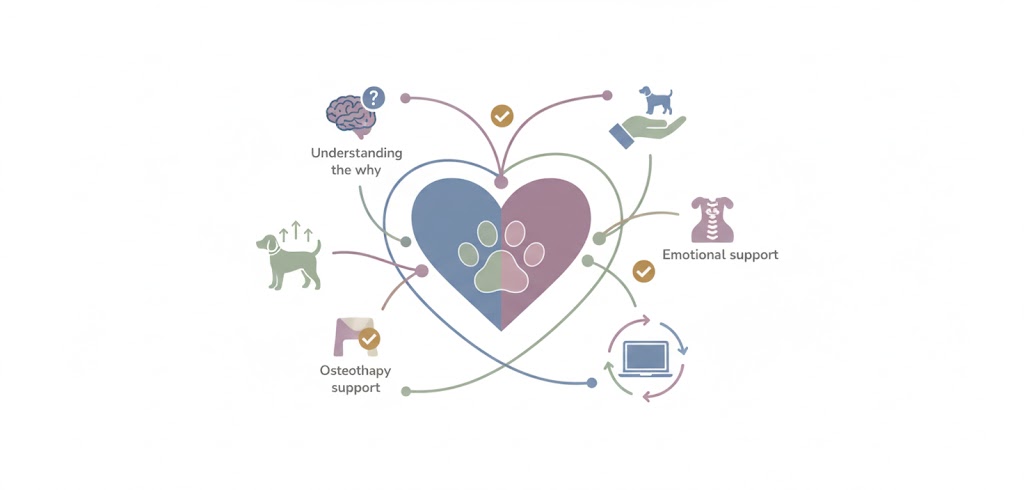
Understand the “Why”: Understand the why behind aggression, reactivity, or fear-based behavior through observation.
Science-Based Behavior Modification: for biting, lunging, resource guarding, and severe reactivity.
Emotional & Osteopathy Support: including guidance on when pain or discomfort may be driving the behavior.
Effective Remote Coaching: even for dogs who can’t safely leave the house or meet new people.
Strengthen the Human-Animal Bond: between you and your dog, especially after other approaches haven’t worked.
Invest in the Relationship You Want With Your Dog
I know how hard it is to deal with this alone, and I don’t want cost to be the reason you don’t get help. If money is tight, reach out. We’ll figure something out together.
Initial Assessment / Intake — €70: A one-on-one session to assess your dog’s specific triggers and history, and outline a training plan built around them. If you go on to book the a package, the €70 is credited toward it.
Ongoing Program / 8 Week Training Package — €650: Daily training plans, video and data analysis, and weekly check-ins to track progress.
Follow-up / Second Opinion Consultations — €100: For dog guardians already working with other professionals or in need of a second opinion, need help navigating a setback, or guidance beyond a generic protocol.
Crisis/Safety Consultation — €90: For guardians whose dogs are showing challenging behaviors right now, like biting, growling, or snapping. If your situation feels urgent, this gets you fast, focused guidance and a safety plan without waiting for a full program to start.
Book a free call with me
Please note I speak fluent Spanish, English, Portuguese, and Italian.



Frequently Asked Questions (FAQ)
Yes — and remote training is actually the best practice for separation anxiety.
Training and medication aren’t either/or, they often work best together. I’m not a veterinarian and can’t prescribe medication, but I can help you recognize when a vet or veterinary behaviorist consult may be worth exploring alongside training.
Yes — it is aboslutely important that we suspend absences and that your pup is not left alone until we have built a good amount of comfort around alone time. Training sessions are short and easy (no more than 20 minutes each time) to fit into daily life. But do not worry! As long as your pup is not left alone, it can be you or anyone else you trust staying with him or her. I can brainstorm different options and help you with this key part of the process.
Every dog is different, so giving a potential timeframe would be outward lying. We usually offer to start with a 4 week package in which we deploy a protocol that includes 4 trainings per week and one reassessment. After this initial 4 weeks, we usually take a call with the client to see how to move forward. At the end, the idea is to make sure your dog learns to be comfortable alone, not to put up with it.
Yes, when there’s a clear plan in place. Part of the initial assessment is understanding exactly what happened and building safety measures, like management strategies, muzzle training if needed, around that specific history.
No. Dogs of any age can benefit from training; puppies that start early may avoid long-term anxiety, and older dogs can still learn new patterns
All dogs are different so we can’t say they will display the same behaviors but some common ones are barking/howling, destruction (chewing, scratching), house-soiling, pacing, drooling, and attempts to escape when they are left alone. But this is not the only way to determine this. We will start with an initial assessment where I will watch your dog live after you leave your house to determine if they are uncomfortable alone.
Absolutely no! There was nothing you did or did not do as a dog owner/dog parent to cause separation distress in your dog. Rest assure of this. What we know from science is that mammals have types of attachment – these can be secure or insecure, and we know that they can be based on past traumas and life experiences. We know that separation anxiety is deeply related to the type of attachment your dog may have which is not a reflection of your love and care for them.