
Helping Your Dog Feel Safe When Home Alone
Fear Free • Science-informed • Gentle • Fully remote
Sessions can be conducted in Spanish, English, Portuguese, and Italian
How It Works
Discovery Call
Initial Assessment
Custom Training
Daily Support
Weekly Meet-ups
In a 30-minute conversation, we discuss how to better help you and your pup
Here we determine for how long is your pup comfortable alone
We design a step-by-step protocol tailored to your dog’s progress and comfort level
I update the training plan each day so your dog always works under threshold.
On a weekly basis, we review progress and make sure you feel supported and that your pup is ok
Fully Remote Format: training sessions are conducted through zoom to avoid triggering your pup and let you be comfortable at home
| Why It Works | What’s Included | Results You Can Expect |
| Uses systematic desensitization Always under threshold Builds lasting emotional resilience Backed by science and evidence | Initial consultation + assessment Daily training plans Video review and data analysis Weekly 1:1 meetings Unlimited messaging support Progress tracking dashboard | Calmer alone-time Reduced vocalization & escape attempts Improved quality of life for both dog and guardian Confidence, predictability, and relief |
Pricing
I understand how difficult separation anxiety can be to navigate on your own, and I don’t want dedicated guardians to miss out on the support they need because of financial constraints.
For this reason, pricing varies depending on location and individual circumstances — book a discovery call so we can discuss the most suitable options for you.
Is this program for me?
Does your dog bark when left alone? Do you feel overwhelmed, exhausted and trapped in your house? Do you feel like you have run out of options?
Yes — and remote training is actually the best practice for separation anxiety.
Yes — it is aboslutely important that we suspend absences and that your pup is not left alone until we have built a good amount of comfort around alone time. Training sessions are short and easy (no more than 20 minutes each time) to fit into daily life. But do not worry! As long as your pup is not left alone, it can be you or anyone else you trust staying with him or her. I can brainstorm different options and help you with this key part of the process.
Every dog is different, so giving a potential timeframe would be outward lying. We usually offer to start with a 4 week package in which we deploy a protocol that includes 4 trainings per week and one reassessment. After this initial 4 weeks, we usually take a call with the client to see how to move forward. At the end, the idea is to make sure your dog learns to be comfortable alone, not to put up with it.
No. Dogs of any age can benefit from training; puppies that start early may avoid long-term anxiety, and older dogs can still learn new patterns
All dogs are different so we can’t say they will display the same behaviors but some common ones are barking/howling, destruction (chewing, scratching), house-soiling, pacing, drooling, and attempts to escape when they are left alone. But this is not the only way to determine this. We will start with an initial assessment where I will watch your dog live after you leave your house to determine if they are uncomfortable alone.
Absolutely no! There was nothing you did or did not do as a dog owner/dog parent to cause separation distress in your dog. Rest assure of this. What we know from science is that mammals have types of attachment – these can be secure or insecure, and we know that they can be based on past traumas and life experiences. We know that separation anxiety is deeply related to the type of attachment your dog may have which is not a reflection of your love and care for them.
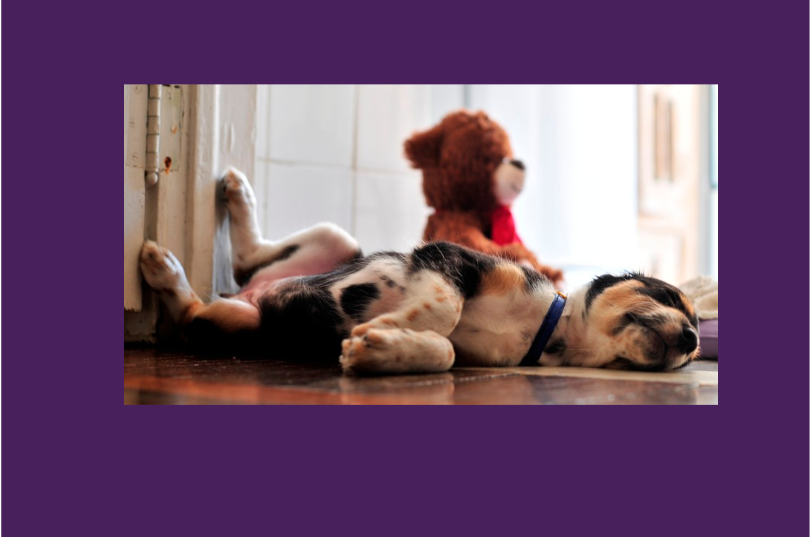
If you made it this far, here is a bonus of cute pups sleeping for you to pawse and enjoy, have a nice day!😉